
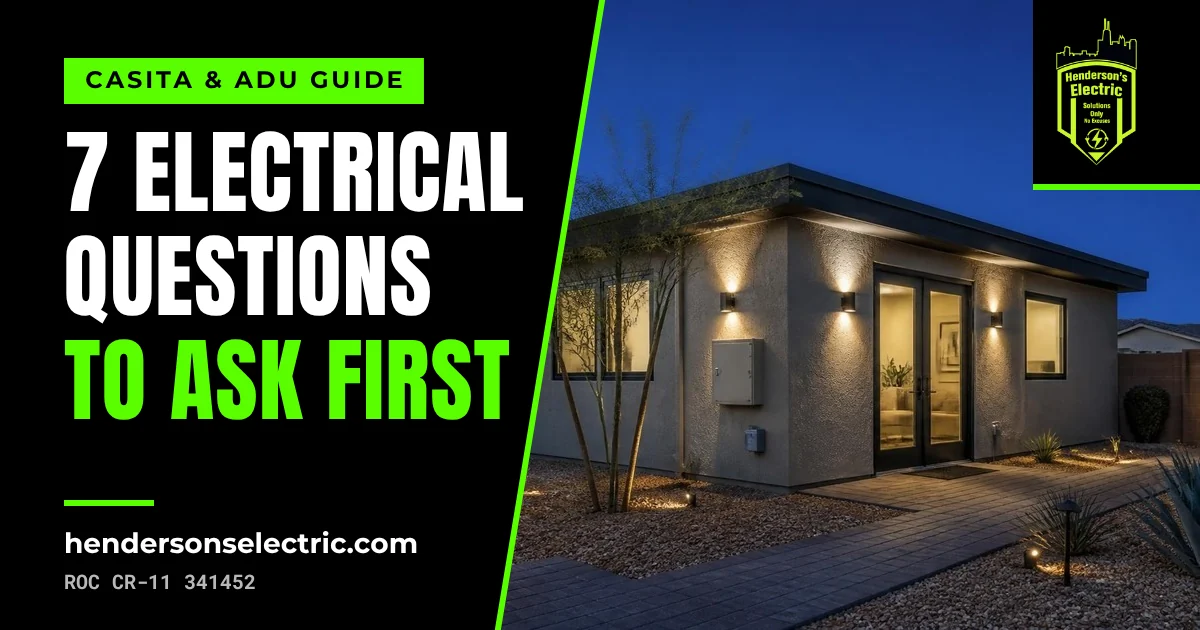
More families in Queen Creek, San Tan Valley, Gilbert, and across the East Valley are building casitas and ADUs (accessory dwelling units). Some are for aging parents, some for grown kids, some for guests or a home office. Whatever the reason, a casita is a small home of its own, and it needs its own plan for power.
The electrical side is easy to underestimate. It affects your budget, your schedule, and sometimes even your floor plan. Here are seven questions we recommend answering early, ideally before the plans are final.
Short answer: Before you finalize casita plans, get a load calculation to see whether your existing service can carry the casita, decide between a subpanel, panel upgrade or new service, ask early about a separate meter, list every appliance and circuit, plan the feeder trench, and confirm who pulls the permit.
1. Can my existing electrical service handle a casita?
This is the big one. Your home’s electrical service and main panel only have so much capacity. A casita adds a lot of new load at once: heating and cooling, a water heater, kitchen appliances, laundry, and lighting.
The way to find out is a load calculation. It adds up what your main house already uses and what the casita will need, and shows whether your current service can carry both. Guessing here is how projects run into surprises halfway through.
2. Will I need a subpanel, a panel upgrade, or a new service?
Most casitas get their own subpanel, fed from the main panel at the house. That gives the casita its own breakers, so you’re not walking back to the main house when something trips.
If the load calculation says your main panel is already close to full, the answer may be a panel upgrade or a larger electrical service. We usually install Square D or Eaton panels, and we’ll explain which option fits your property and why. The current electrical code requires whole-home surge protection when a home’s electrical service is installed or replaced, so we include it on every job that touches the panel and recommend it for every home.
3. Should the casita have its own electric meter?
Some homeowners want a separate meter, especially if the casita will be rented or used by another household. Whether that’s possible depends on your electric utility’s requirements and on your town, city, or county rules.
This is a question to ask early. A separate meter changes how power gets to the casita, so it’s much easier to plan for it from the start than to change course later.
4. What circuits will the casita need?
A casita usually needs many of the same dedicated circuits as a full home. Plan for these up front:
- Heating and cooling, such as a mini-split or a small packaged unit
- Water heater (electric tank or tankless, which can be a big load)
- Kitchen or kitchenette appliances: range or cooktop, microwave, refrigerator, dishwasher
- Laundry, if the casita will have its own washer and dryer
- Bathroom circuits with GFCI protection where required
- An EV charger, if anyone living there drives electric
- Outdoor lighting and receptacles for patios and walkways
Every one of these adds to the load calculation, which is why it’s worth deciding on appliances before the electrical is designed.
5. How will power get from the house to the casita?
A detached casita needs a feeder run from your main panel or service to the casita’s subpanel. That usually means trenching across the yard. The distance, the route around pools, patios, and landscaping, and the size of the feeder all affect the work involved.
If you’re also planning pavers, a pool, or new landscaping, coordinate the trench early so you only dig once.
6. Who pulls the permit, and how do inspections work?
Casita and ADU electrical work almost always needs a permit and inspections from your local building department. Who holds the permit depends on how the project is set up:
- GC-led projects: The general contractor usually holds the permit, and we schedule our rough-in and trim-out around the rest of the build.
- Homeowner-hired projects: Henderson’s pulls the electrical permit where one is required and meets the inspector for you.
If the job involves a panel or service change, we also schedule the SRP or APS disconnect and reconnect, so you don’t have to call the utility yourself.
7. Is this a good time to upgrade the main house too?
Often, yes. If you’re already upgrading the panel or service for a casita, it can be a smart time to handle other projects on your list, like updated lighting, Lutron controls, or replacing aging wiring in an older home. Doing the work together can mean one permit, one utility disconnect, and less disruption.
If the main house is older, ask whether whole-home rewiring makes sense. For lighting ideas inside the new casita, see our lighting installation page.
A simple casita electrical checklist
Before you finalize plans, try to have answers to these:
- What appliances and HVAC will the casita have?
- Has a load calculation been done on the main house plus the casita?
- Do I need a subpanel only, or a panel upgrade or new service?
- Do I want a separate meter, and have I asked whether it’s allowed?
- Where will the feeder trench run?
- Is a general contractor running the project, and who holds the permit?
Not sure about some of these? That’s normal. It’s exactly what we help with on a walkthrough. Learn more on our remodel, ADU/casita, and addition electrical page.
When should I call an electrician?
Call before your casita plans are final, ideally while you’re still choosing appliances and HVAC, so the load calculation can shape the design instead of forcing changes later. If you’re adding a casita to a home with an older or crowded panel, or breakers already trip when big appliances run, mention it on the first call. Don’t open the panel or try to add circuits yourself.
Serving Queen Creek and the East Valley
We plan and wire casitas and ADUs in Queen Creek, San Tan Valley, Gilbert, Mesa, Chandler, Florence, Scottsdale, Apache Junction and Gold Canyon, Sun Lakes, Tempe, Cactus Forest, Coolidge, Paradise Valley and Ahwatukee.
Frequently asked questions
Do I need a permit to add electrical service to a casita?
In most cases, yes. New feeders, subpanels, and service changes typically need a permit and inspections from your town, city, or county. Henderson’s pulls the electrical permit where required, and on GC-led projects the general contractor usually holds it.
Can my current panel power a casita?
Sometimes. A load calculation shows whether your existing panel and service can carry the main house and the casita together, or whether you need a panel upgrade or a larger service.
Does a casita need its own subpanel?
Most do. A subpanel fed from the main panel gives the casita its own breakers, so you can reset a tripped circuit without walking back to the main house.
Can a casita have its own electric meter?
It depends on your electric utility’s requirements and your local rules. Ask early, because a separate meter changes how power is brought to the casita.
Do you work with general contractors on ADUs and casitas?
Yes. We work with general contractors and with homeowners who manage their own projects, and we schedule rough-in, inspections, and trim-out around the rest of the build.
Planning a casita or ADU? Talk to Randy first
Henderson’s Electric Solutions LLC is a family-owned electrical contractor in Queen Creek, owned by Randy and Tori Henderson. Randy is our licensed electrician (ROC CR-11 #341452), and we’re bonded, insured and BBB accredited. We help homeowners and general contractors across the East Valley plan casita electrical the right way, from load calculation to final inspection.
Call Randy at (480) 430-2775 or request an estimate online. Regular hours are Monday through Friday, 6 AM to 6 PM, and we answer emergency calls 24/7. Solutions Only - No Excuses.