
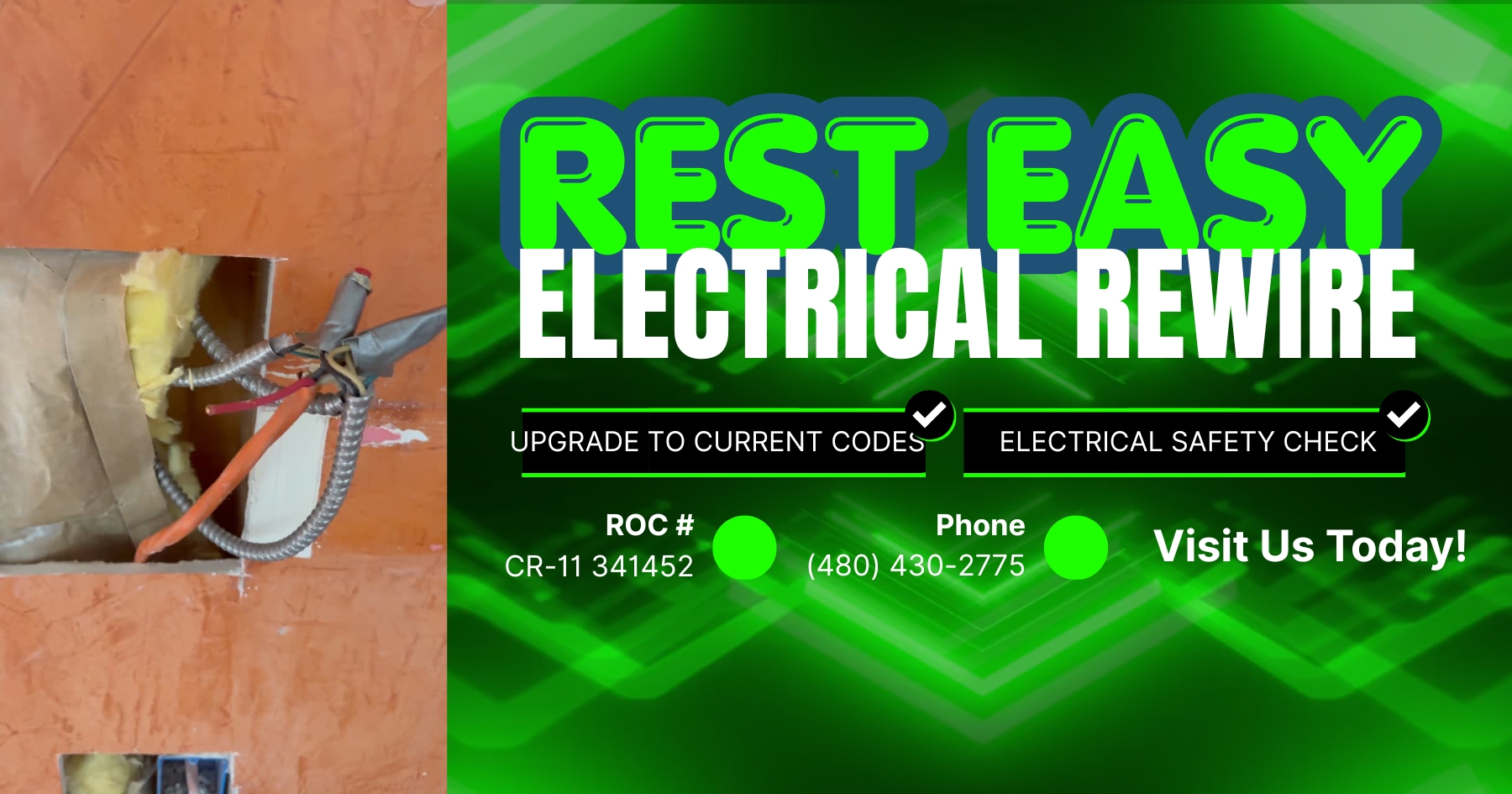
Out in Queen Creek, Florence, Gold Canyon, San Tan Valley and the quieter edges of the Valley, plenty of homes and shops hide their electrical history behind drywall. You can’t see it until something fails. Sometimes a repair is all you need. Sometimes the wiring was built for a different era, and a rewire is the only way to make it truly safe.
Short answer: Your house may need rewiring if it has two-prong ungrounded outlets, cloth or brittle insulation, older aluminum branch wiring, breakers that trip often, warm switches or outlets, flickering lights or burning smells. An electrician’s inspection tells you whether targeted repairs will do, or whether a full rewire is the safer path.
What is a whole-home rewire?
A whole-home rewire replaces the branch circuits, outlets, switches and often the panel, so the building can carry modern loads without overheating, arcing or hidden faults. Older wiring was designed for a few lights, a refrigerator and maybe a window AC unit. It wasn’t built for EV chargers, home offices, tankless water heaters and large central air systems. A repair fixes one outlet. A rewire removes the pattern of problems that made it fail.
What are the signs your house needs rewiring?
- Two-prong outlets in bedrooms and living areas (ungrounded circuits)
- Cloth-wrapped, rubber or brittle insulation where wiring is visible
- Older aluminum branch wiring, or an inspection report that mentions it
- Breakers that trip with no clear overload
- Lights that flicker or dim when the AC or microwave starts
- Switch plates or outlets that feel warm, buzz or spark
- A burning smell near outlets or the panel
- Signs of DIY additions: extension cords as permanent wiring, mismatched devices, splices without boxes
- A home inspector’s note to “recommend evaluation by a licensed electrician”
Business owners see different clues: lights that dim when equipment starts, panels with no spare spaces, or a previous tenant’s tangle of added circuits. These signs show up in older homes in Mesa as often as on rural properties around Apache Junction and Gold Canyon or Coolidge, especially after monsoon storms, dust storms or a season of pests in the attic.
Is aluminum wiring dangerous?
Some homes built in the mid-1960s and 1970s used small-gauge aluminum branch wiring. The U.S. Consumer Product Safety Commission has warned that its connections can overheat and become fire hazards. Aluminum expands and contracts more than copper, oxidizes at connections and can loosen under load until a joint starts to arc. If you have it, have an electrician evaluate it. Approved repair methods or rewiring with copper can make it safe.
Do code changes mean I have to rewire my house?
Not automatically. The National Electrical Code is updated every few years, but Arizona cities and counties each adopt their own edition and amendments. That’s why we confirm the local rules before designing a rewire. Existing wiring that was installed correctly and left alone is often allowed to stay.
The trigger is new work. A panel change, addition, kitchen or bath remodel, service upgrade or tenant improvement has to meet the current local code. That can include grounding, GFCI protection, AFCI protection on many living-area circuits, tamper-resistant outlets and accessible junction boxes. That’s how a house that passed inspection decades ago becomes an inspection problem today.
Why are hidden splices in the walls a problem?
Code requires splices to be inside an accessible junction box with a cover, not taped together inside a wall, attic chase or soffit. Over years of DIY projects, “temporary” repairs and corner-cutting, illegal in-wall splices pile up where nobody can see them. Heat has nowhere to go, insulation cracks, and a nail or a rodent becomes the last straw. During a rewire, we trace circuits and bring those surprises into the light. When a splice is needed, it goes in a labeled box you can find later.
Can I do a partial rewire instead?
Sometimes. If the problems are limited to a few circuits or one part of the house, targeted repairs or a partial rewire may be enough. If the whole system is ungrounded, aluminum, brittle or full of unknown splices, patching keeps costing you time and leaves risk behind. An inspection gives you an honest answer either way. Our home electrical inspection post explains what we check.
What does a whole-home rewire with Henderson’s involve?
- Inspect and map. We trace the existing circuits and note problems.
- Check capacity. We confirm your service and panel can carry the new design. A panel upgrade often goes with a rewire. If the home still has a Federal Pacific (Stab-Lok) or Zinsco panel, we’ll talk about replacing it at the same time. We usually install Square D or Eaton panels and materials, and we coordinate SRP and APS disconnects and reconnects.
- Design to local code. We plan dedicated kitchen and laundry circuits, GFCI and AFCI protection where required, lighting, and readiness for an EV charger or solar.
- Permit. We pull the electrical permit where required.
- Rewire. We coordinate with your remodel or drywall schedule. If walls are already open, that’s the easiest time.
- Inspect and label. The work is inspected, and you get a clearly labeled panel.
Randy leads the field work and treats every house like his own, and Tori keeps scheduling, communication and estimates clear. Learn more on our whole-home rewiring page.
What about commercial rewiring?
Offices, retail suites, warehouses and tenant improvements outgrow their original circuits as equipment, refrigeration and lighting needs grow. Newer code editions can also expand GFCI and arc-fault requirements beyond what an old suite was built for. We plan cutovers and phased circuits whenever the space allows, so the business can stay open. See our commercial tenant improvements page.
When should I call an electrician?
- Any of the warning signs above
- An inspection report mentions aluminum wiring, knob-and-tube or ungrounded circuits
- You’re planning a remodel, addition or panel upgrade in an older home
- A breaker trips again right after you reset it
If an outlet or switch is hot, smells like burning or sparks, stop using it and turn off its breaker if you can do so safely. Don’t open walls or outlets to look. If there’s smoke or fire, get out and call 911. Then call our emergency electrician line. We answer emergency calls 24/7.
Serving Queen Creek and the East Valley
We rewire homes and businesses in Queen Creek, San Tan Valley, Gilbert, Mesa, Chandler, Florence, Scottsdale, Apache Junction and Gold Canyon, Sun Lakes, Tempe, Cactus Forest, Coolidge, Paradise Valley and Ahwatukee.
Frequently asked questions
How do I know if my house needs to be rewired?
Common signs are two-prong ungrounded outlets, brittle or cloth insulation, older aluminum branch wiring, breakers that trip often, warm or buzzing outlets and switches, flickering lights and burning smells. An electrician’s inspection tells you whether repairs or a rewire is the right fix.
Can a house be rewired without removing all the drywall?
Often, yes. Rewiring an occupied home usually means cutting smaller access openings rather than removing whole walls, and those openings need patching afterward. If you’re already remodeling with walls open, that’s the easiest time to rewire.
Do I need a permit to rewire my house?
Yes, rewiring is electrical work that typically needs a permit and inspection from your city, town or county. Henderson’s pulls the permit where required.
Can I replace two-prong outlets with three-prong outlets?
Not by simply swapping the outlet. A three-prong outlet needs a ground. Options include running a ground or new circuit, or adding GFCI protection, which the electrical code allows for ungrounded outlets when they’re labeled correctly. An electrician can tell you which fits your home.
Should I upgrade my panel when I rewire?
Often it makes sense. New wiring into an old, full or undersized panel is only half a fix. We check your panel and service as part of planning a rewire and tell you honestly if it needs an upgrade.
Do you rewire commercial buildings?
Yes. We rewire offices, retail suites, warehouses and tenant improvement spaces, and we plan phased work whenever the space allows so the business can keep running.
Talk to us about a rewire
Henderson’s Electric Solutions LLC is a family-owned electrical contractor in Queen Creek, owned by Randy and Tori Henderson. Randy is our licensed electrician (ROC CR-11 #341452), and we’re bonded, insured and BBB accredited. We’ll inspect, explain which code rules apply in your city, and give you a clear path to a safe system.
Call Randy at (480) 430-2775 or request an estimate online. Regular hours are Monday through Friday, 6 AM to 6 PM, and we answer emergency calls 24/7. Solutions Only - No Excuses.