
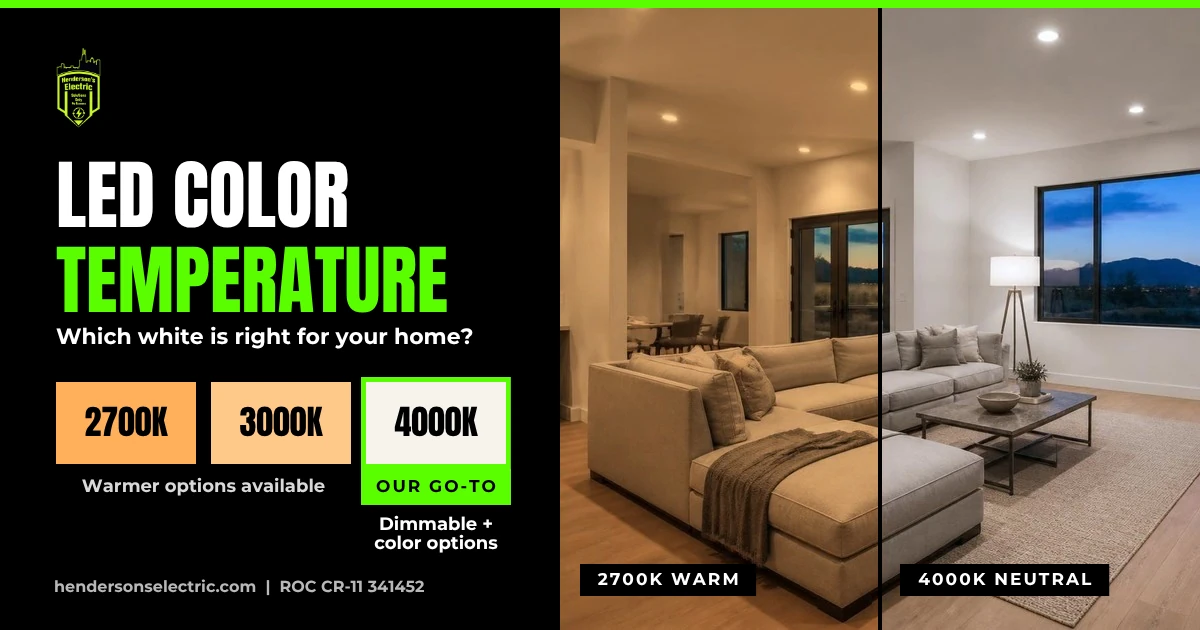
When homeowners in Queen Creek, Gilbert and Scottsdale plan new lighting, one question comes up every time: what color should the lights be? LED fixtures and bulbs come in a range of color temperatures, from golden to bluish white, and the choice changes how every room looks and feels.
Short answer: Our go-to is 4000K LED lighting on dimmers, using color-selectable fixtures. 4000K gives clean, natural white light in every room, dimming softens it at night, and a switch or setting on each fixture lets you go warmer, like 2700K or 3000K, whenever you want. Keep one color temperature per room.
What is LED color temperature?
Color temperature describes how warm or cool white light looks. It’s measured in Kelvin (K). Lower numbers look warmer and more golden, and higher numbers look cooler and bluer:
- 2700K: warm and golden, similar to a classic incandescent bulb
- 3000K: warm white, a little crisper than 2700K
- 4000K: neutral, clean white light
- 5000K and up: daylight, bright and noticeably bluish
Why do we usually recommend 4000K with dimming and color options?
In our experience, most homeowners are happiest with 4000K in every room, for all of their lighting, as long as it’s dimmable and on color-selectable fixtures so they can change their minds later. Here’s why 4000K makes a good starting point:
- It looks clean and natural. 4000K is a neutral white that doesn’t look yellow or blue.
- It’s easy to see by. Kitchens, bathrooms, closets, garages and offices all benefit from clear, bright light.
- It keeps the whole house consistent. One color temperature throughout means no patchy mix of yellow and white light between rooms.
- It works with modern finishes. White, gray and natural stone finishes look crisp, not dingy.
Why does dimming matter so much?
Dimming is what makes 4000K work all day. Bright light is great for cooking, cleaning and getting ready. In the evening, dimming takes the edge off and makes a room feel relaxed. We put lighting on dimmers wherever it makes sense, and our Lutron lighting controls let you set scenes so a single button gets each room to the right level.
One tip: the dimmer has to be compatible with your LEDs. A mismatched dimmer can cause flicker, buzzing or lights that won’t dim smoothly.
What are color-selectable (switchable CCT) LED fixtures?
Color-selectable fixtures, also called switchable CCT, let you choose the color temperature yourself. Most have a small switch on the fixture or its driver, or a setting in an app, with several options such as 2700K, 3000K, 3500K, 4000K or 5000K. The exact choices vary by product, so check the specific fixture. We typically set them at 4000K, and if you’d rather have warmer light in a bedroom or living room, you can switch it without replacing anything.
That flexibility is the main reason we recommend them. You get our usual 4000K look on day one, and the option to go warmer whenever you want.
What’s the difference between switchable CCT, dim-to-warm and tunable white?
- Switchable CCT (color-selectable): you pick one color temperature from a set of options with a switch or setting, and the light stays that color as it dims. This is our go-to.
- Dim-to-warm: the light gets warmer automatically as you dim it, the way an incandescent bulb does, ending in a soft amber glow. You don’t choose the color directly.
- Tunable white: you adjust the color temperature anytime from an app, keypad or lighting control system, usually across a continuous range. It needs compatible controls.
When is warmer 2700K to 3000K lighting a better fit?
Some homeowners simply prefer a softer, more golden glow, especially in living rooms and bedrooms, or in homes with lots of warm wood and earth tones. That’s a perfectly good choice. With color-selectable fixtures, going warmer is just a switch setting, and you can change it back later. If you know you want warm light everywhere, fixed 2700K or 3000K fixtures or dim-to-warm fixtures work well too.
If you’re unsure, start at 4000K on color-selectable fixtures and switch one room to 3000K to compare.
Should I mix color temperatures in my home?
Within a room, no. Mixed color temperatures make a space look patchy, with some fixtures yellow and others white. Across the whole house, one color temperature is simplest and looks the most consistent, which is a big reason 4000K throughout works so well. If you do choose a warmer temperature for certain rooms, keep each room consistent and buy fixtures from the same product line when you can.
What is CRI?
CRI (Color Rendering Index) measures how accurately a light shows colors compared with natural light. A higher CRI makes wood, stone, paint, fabrics and skin tones look more true to life, while a low CRI can make them look flat or slightly off. You’ll find it on the fixture’s spec sheet or packaging, and it’s worth comparing when you’re choosing between products.
What about outdoor lighting?
The same thinking applies outside: pick one color temperature and stick with it for landscape, patio and security lighting. For rooflines, our permanent lighting can run white light every night and switch to colors for holidays and game days. For layering ideas inside and out, see our post on layered lighting in East Valley luxury remodels.
LED color temperature checklist
- Choose color-selectable (switchable CCT) fixtures where available
- Start with 4000K throughout, unless you prefer a warmer look
- Check which color settings each fixture offers
- Put lighting on dimmers wherever you can
- Use LED-compatible dimmers
- Keep one color temperature per room, ideally across the whole house
- Compare CRI on the spec sheet
When should I call an electrician?
Swapping a bulb is a homeowner job. Call an electrician to add or move fixtures, install dimmers or lighting controls, add under-cabinet lighting or fix lights that flicker even with new bulbs. Call right away if a fixture or switch feels hot, buzzes loudly or smells like burning. Turn it off at the breaker only if it’s safe and dry to reach, and call 911 for any fire. Our lighting installation team can help you plan the whole house.
Serving Queen Creek and the East Valley
We design and install lighting in Queen Creek, San Tan Valley, Gilbert, Mesa, Chandler, Florence, Scottsdale, Apache Junction and Gold Canyon, Sun Lakes, Tempe, Cactus Forest, Coolidge, Paradise Valley and Ahwatukee.
Frequently asked questions
What color temperature LED lights should I use in my home?
Our go-to is 4000K throughout, on dimmers, using color-selectable fixtures. It gives clean, natural-looking light in every room, dimming softens it in the evening, and you can switch to a warmer setting like 2700K or 3000K whenever you want.
Is 4000K too bright or cold for a living room?
On a dimmer, it rarely is. Bright 4000K works for daytime and tasks, and dimming makes the room feel relaxed at night. With color-selectable fixtures, you can also switch that room to 3000K or 2700K if you prefer a warmer look.
What are color-selectable or switchable CCT lights?
They’re LED fixtures with a switch or setting that lets you choose the color temperature, often from options like 2700K, 3000K, 3500K, 4000K and 5000K. The available settings vary by fixture, so check the product details.
What is the difference between switchable CCT and dim-to-warm?
Switchable CCT lets you pick one color temperature and keeps it as the light dims. Dim-to-warm changes color automatically, getting warmer as you dim, without letting you choose a specific setting.
What is the difference between 3000K and 4000K?
3000K is a warm white with a slight golden tone. 4000K is a neutral, clean white. Many homeowners find 4000K looks fresher and more natural, especially with white and gray finishes.
Why do my LED lights flicker when dimmed?
Usually the dimmer isn’t compatible with the LED bulbs or fixtures. An electrician can install a dimmer matched to your lighting.
Ready to plan your lighting?
Henderson’s Electric Solutions LLC is a family-owned electrical contractor in Queen Creek, owned by Randy and Tori Henderson. Randy is our licensed electrician (ROC CR-11 #341452), and we’re bonded, insured and BBB accredited. See all of our electrical services.
Call Randy at (480) 430-2775 or request an estimate online. Regular hours are Monday through Friday, 6 AM to 6 PM, and we answer emergency calls 24/7. Solutions Only - No Excuses.